What a News Report Can Establish
Learn how to read a news report’s evidence, spot the limits of documents and images, and keep its supported details separate from unresolved claims.
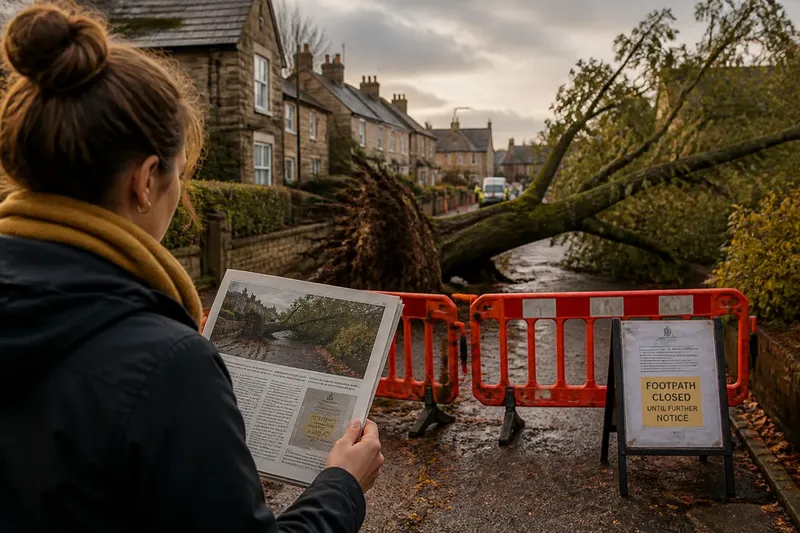
A report says a footpath is closed after a tree fell, but the council notice it cites only confirms the closure. That difference matters: the notice can support what the council announced without establishing why the tree fell or who was responsible. Reading news reports carefully means paying attention to the reach and limits of each piece of evidence.
A report can be useful without answering every question. The task is not to dismiss an account whenever something remains uncertain, but to avoid extending its evidence beyond what it can support.
A report supports only the claim its evidence can reach
Evidence has a scope. A reporter who sees barriers across a road can describe the road as closed at that time. A council notice can establish that the council announced a closure. Neither observation alone explains the reason or tells you when the road will reopen.
The same limit applies to records and recordings. A meeting minute can establish that a decision was recorded; it may not explain every participant’s reasoning. A video can show someone entering a building, but it cannot reveal what happened outside the frame or what that person intended.
When reading a sentence, ask what a reader could point to as support for its precise wording. If the support establishes only a narrower detail, keep the claim narrow too.
Documents and images have boundaries
A document is evidence of its contents, not automatic proof that every statement inside it is correct. A report that identifies a signed council notice can tell you what the notice says. To establish that the underlying explanation is accurate, it may need other support, such as records or independently described observations.
Images need similar care. A photograph can show a visible scene, but its caption, date, location and framing affect what you can infer. A picture of a queue outside a clinic does not by itself establish why people are waiting or how long they have been there.
Notice whether a report identifies where a document or image came from and what it can actually show. Missing context does not make the material false; it limits the conclusions you can draw from it.
Attribution keeps a claim attached to its source
Phrases such as “the company says”, “police allege” and “residents reported” identify who is responsible for a statement. They do not, on their own, establish that statement as fact, even when the source has direct access or official authority.
A council might confirm that it received complaints while the claims within those complaints remain unverified. A company may explain why it made a decision, but its account of the reason is still its account unless the report supplies further support.
Keep the attribution when you retell the story. “Residents said the water smelled unusual” is not interchangeable with “the water was unsafe”; each sentence makes a different claim.
Cause and sequence are not the same
Reports often describe two events close together. “The shop closed after an inspection” establishes a sequence if both details are supported; “the inspection forced the shop to close” asserts a causal link. That stronger claim needs evidence connecting the inspection to the decision.
Imagine a school cancels an outdoor event on the morning of a weather warning. A report identifies the cancellation and the warning, and the school says it acted because of the forecast. Those details support the timing and the school’s explanation; they do not establish that the warning was the only reason. If the report cites a written decision naming additional concerns, those become part of the evidence too, without settling anything the document does not address.
Separate what happened, what followed and what caused it. Each may need different support.
Uncertainty marks the edge of the account
Wording such as “the cause is not known” or “the figures could not be independently confirmed” tells you where the report’s evidence stops. These qualifications are part of the account, not details to drop when recalling the story.
An absent response does not settle what a person or organisation would say. A report may tell you that a request for comment was made and unanswered; if it does not, the silence in the article could simply mean the detail is not included. In either case, absence is not evidence that a particular explanation is true.
Keep “not established in this report” distinct from “false”. An open question can remain open without making the rest of the account worthless.
How do I judge what a report can establish?
Does a named source make a claim a fact?
No. Naming a source shows who made the claim, not whether the claim has been independently supported. Preserve wording such as “the organisation says” when you repeat it.
Does a document prove everything written in it?
No. A clearly identified document can support what it records or states, but its statements may still need corroboration. Check whether the report establishes the document’s origin and distinguishes its contents from independently confirmed facts.
What does “could not be independently confirmed” mean?
It means the report has not confirmed the claim through separate evidence or sources. Treat it as unresolved for now, rather than as either established or disproved.
Can a report be useful while leaving questions open?
Yes. It may establish an event or describe a decision while leaving motive, cause or future consequences unsettled. Note which question remains open instead of supplying your own explanation.
A brief check before you share a report
Before sharing, choose the sentence you plan to pass on and compare it with the evidence the report actually gives. The following checks help you keep the wording within those limits:
- If a reporter directly observed a condition, check that the report says when and where; if those details are missing, describe only what the report states and avoid implying it continues now.
- If a claim comes from a named person or organisation, check whether it is independently supported; if not, retain the attribution, and if it is supported, state only the part the additional evidence reaches.
- If a document is cited, check whether the report identifies its source and what it records; if its origin is unclear, say that the report refers to a document rather than treating its contents as confirmed.
- If an image is central, check whether its date, location and context are given; if any are missing, avoid claims about when, where or why the scene occurred.
- If the report links two events, check for evidence of a causal connection; if it gives only their order, describe the sequence and leave the cause open.
- If a report says a detail could not be confirmed, check which detail is uncertain; if the uncertainty concerns one claim, keep it attached to that claim rather than casting doubt on unrelated supported details.
Say a reader is about to share a report about a library closing after a building inspection. The report identifies a council notice announcing the closure, quotes a librarian saying the inspection raised concerns, and says the precise reason for closure has not been confirmed. The reader checks the notice and sees that it records the closure but gives no cause; the librarian’s explanation remains attributed; the report’s caveat applies to the reason, not the closure itself. The accurate summary is that the library closed after an inspection, the librarian linked the decision to concerns, and the precise reason remains unconfirmed—not that the inspection was proven to have forced the closure.
For a quick check of what a news report can establish, keep three things in view: the evidence it identifies, the source responsible for each claim, and the questions it leaves unresolved. That habit lets you share useful information without turning a limited account into a broader certainty.